
If you’ve ever doubted the importance of a compelling email subject line, consider this:
- 47% of recipients decide to open an email based solely on the subject.
- Moreover, a staggering 69% use the same criterion to mark an email as spam.
These figures highlight a critical reality: you have just a few characters to grab your reader’s attention and persuade them that your message is worth reading.
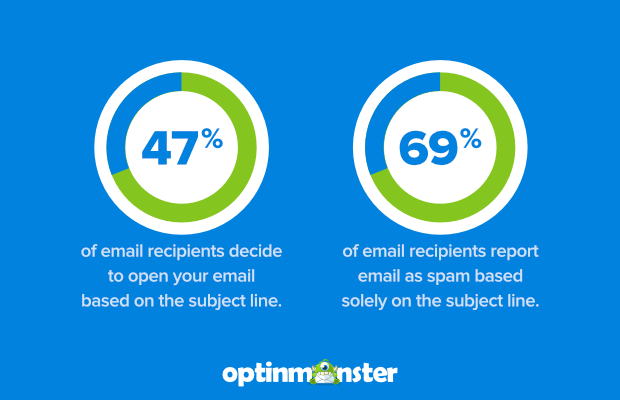
Why Is a Good Email Subject Line Important? By Optinmonster.
As a copywriter, I’ve seen firsthand how a great subject line can make the difference between a successful and a failed campaign. In this post, I’ll guide you through proven tactics and formulas to write email subjects that are practically irresistible. By the end, you’ll have a toolkit of techniques ready to apply to your next email marketing campaign.
The Importance of the Subject Line: First Impressions Count
The subject line of an email is the first interaction your potential customer will have with your message. Think of it as your cover letter. If it’s not relevant it’s likely to be ignored or, worse, end up in the spam folder. A well-crafted subject line can significantly boost open rates, turning it into a key opportunity to capture the reader’s attention.
Remember, the goal of the subject line is not just to secure an open but also to lay the groundwork for a trusting relationship.
Strategies and Formulas for Writing Irresistible Email Subjects
I’ll introduce a series of tactics, organised into 10 key categories, that you can use to create subjects that won’t go unnoticed. Each category includes practical examples for inspiration.
1. Urgency
The principle of urgency is rooted in human psychology; people fear missing out on something important. Leveraging this feeling can dramatically increase open rates.
Formulas for creating urgency in your subjects:
- Last chance to [desired action] before [event or date]
- Example: “Last chance to redeem your discount before 30th September”
- Your [product/service] is about to [negative action] — Act now
- Example: “Your subscription is about to be cancelled — Renew now”
- Only [quantity] [product/service] left — Secure yours before they run out
- Example: “Only 3 tickets left — Secure yours before they’re gone”
2. Curiosity
Curiosity is a powerful motivator. When an email subject creates a mystery or leaves something open to interpretation, it entices the recipient to open the message to satisfy their curiosity. These subjects don’t reveal everything upfront but suggest there is something interesting or valuable to discover.
Try:
- 10 [surprising element] that [benefit or outcome]
- Example: “10 surprising habits that can make you richer”
- We have a [type of offer] surprise for you
- Example: “We have a special gift for you: discover it inside!”
- “Did you know [unexpected or surprising fact]
- Example: “Did you know you can save up to 30% on your purchases today?”
3. Humour
Incorporating humour into your subjects can humanise your brand and connect emotionally with the reader. Don’t be afraid to be creative:
- “You’re not weird, you’re exclusive.” Preheader: “Limited edition with 25% off just for you.”
- “Create the perfect trio 👄” Preheader: “Pillows, sheets, and beds at 30% OFF!”
- “When life gives you lemons, ask for salt and tequila.” Preheader: “2-for-1 this week at our bar!”
In these examples, I use a short and playful headline to capture attention and a preheader to add context and additional details to the offer.
The preheader is the text that appears alongside the subject line in the email preview, providing supplementary information that can boost open rates.
4. Vanity
This approach leverages the desire to feel special and unique. Tapping into this impulse can make your subjects resonate more with recipients, making them feel they are receiving something exclusive.
Formulas for appealing to vanity in your subjects:
- Don’t wear [common or outdated item] — Stand out with [your offer]
- Example: “Don’t wear last year’s fashion — Be the first to showcase the new trends”
- Exclusive to [target group]: [benefit/reward]
- Example: “Exclusive to wine enthusiasts: access our premium selection”
- Unique gifts for [target group] with style
- Example: “Unique gifts for stylish travellers”
5. Problems and Challenges
Demonstrating that you understand your audience’s difficulties and offering a solution can be an effective way to connect with them. Addressing specific problems and presenting clear solutions can boost interest and open rates.
Formulas for addressing problems and challenges in your subjects:
- How to [solve a specific problem] in [short time]
- Example: “How to gain more space in your kitchen in just one afternoon”
- Solution for [common problem]: [benefit or action]
- Example: “Solution for surviving your next overnight flight stress-free”
- Discover how to [achieve a goal] with [simple method]
- Example: “Discover how to learn a language in just 5 minutes a day”
3 Essential Requirements for Effective Email Subjects
For your email subjects to be effective and not end up in the spam folder, they must meet these 3 requirements from the outset:
Relevance: The subject should align with your audience’s interests. An irrelevant subject will not only be ignored but could also damage your brand’s reputation. Avoid empty promises or clickbait; instead, offer real value from the start.
Clarity: A confusing or complex subject can frustrate the reader and lead to them ignoring your email. Keep subjects brief and ensure they accurately reflect the content of the email.
Trust: A subject that delivers on its promise and avoids creating false expectations strengthens the relationship with your subscribers. A good practice is to be honest in the subject line so the reader can trust that the content of the email matches what was promised.
Additional Tips for Improving Your Subjects
- Optimise for Mobile: More than half of emails are opened on mobile devices, so ensure your subjects look good on small screens.
- A/B Testing: Don’t underestimate the power of A/B testing to identify which subjects resonate best with your audience.
- Avoid Spammy Words: Steer clear of terms that might trigger spam filters, such as “free”, “limited offer”, or “earn money”.
Conclusion: The Subject Line is Just the First Step
Remember, a good subject line is only the beginning of effective communication. The content of the email must meet the expectations set by the subject to avoid disappointing the reader or ending up in spam in future.
Recap of the tactics we’ve covered:
- Urgency: Use scarcity psychology to increase opens.
- Curiosity: Spark interest with enigmatic subjects.
- Humour: Connect emotionally with a touch of fun.
- Vanity: Appeal to the desire to feel special.
- Problems and Challenges: Offer solutions to common difficulties.
Essential Requirements: Ensure your subjects are relevant, clear, and build trust. Avoid clickbait and empty promises.
Additional Tips: Optimise for mobile, run A/B tests, and avoid words that trigger spam filters.
With these techniques, you’ll be ready to boost open rates and build strong relationships with your subscribers.
Do you want to keep discovering more secrets on how to optimise your digital marketing?
Follow me on LinkedIn to stay updated on my upcoming articles and useful tips.


